
My Approach

Discover a unique approach to building better partnerships, teams and organizations.

My methods are grounded in an academic background spanning Neuroscience and Governance, and shaped by 20 years of leading teams in some of the world's most complex and consequential environments.

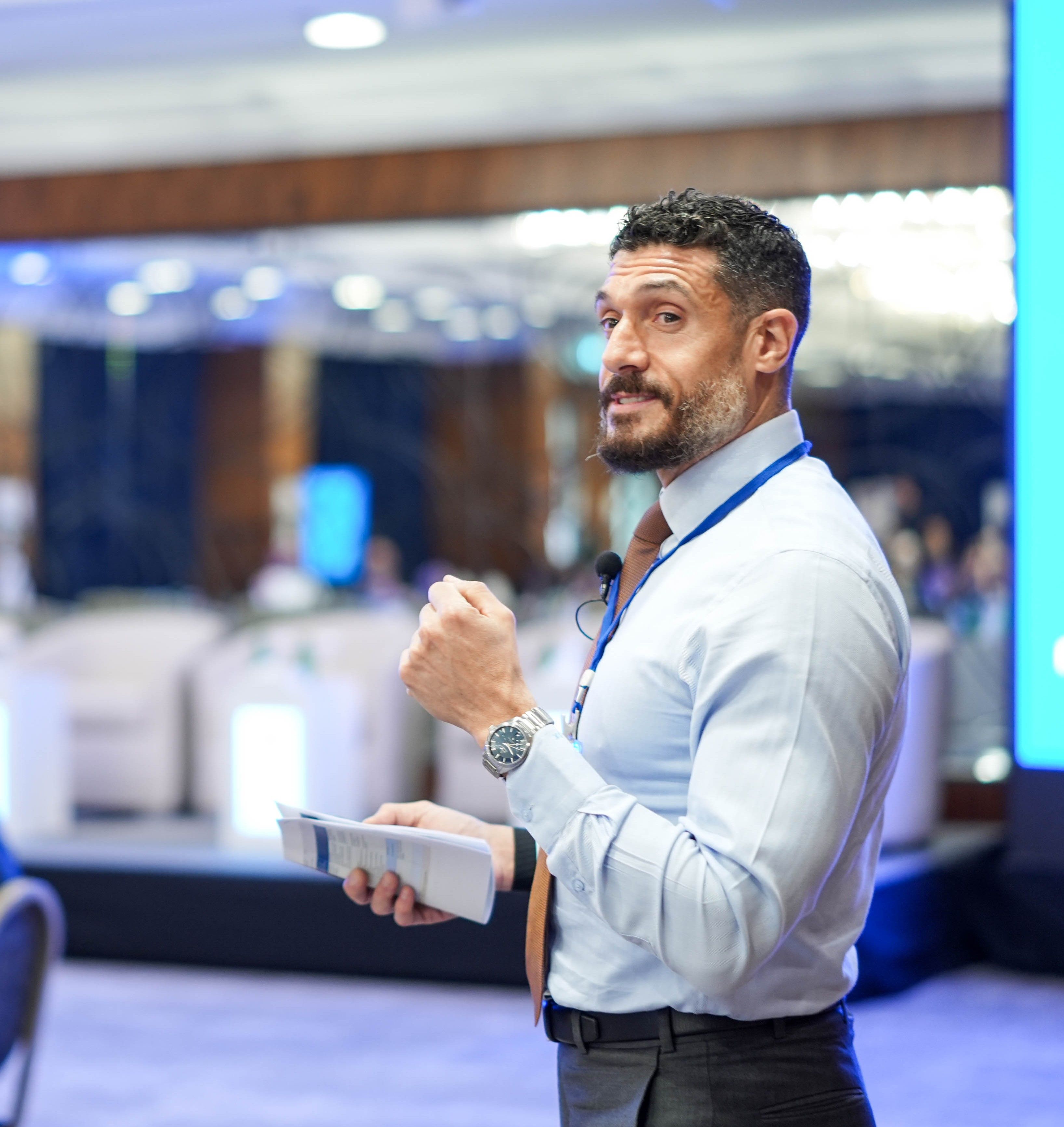
Shareef Khatib engaging participants in a workshop
Why Choose 3Ts

Why choose 3Ts?

Six working principles: structured enough to guide decisions, flexible enough to meet you where you are.

My Methodology

Find the service you need, then go deeper.

01For consequential rooms

Facilitation

Most gatherings generate energy without producing decisions. I design and hold the rooms where that changes: politically sensitive multi-stakeholder processes, leadership off-sites, cross-functional strategy sessions, and decision convenings where alignment is earned and owned, rather than assumed. My methods do not manage the conversation, but listen for what is underneath it: the underlying narrative, the unspoken resistance, the connection no one has yet vocalized. I play that back with precision, so senior teams can make informed choices and leave with decisions that hold under the stress of real implementation.

02For leaders at inflection points

Coaching

I work with senior leaders who are navigating complexity, carrying transformation mandates, or standing at a genuine inflection point in their careers. My approach is disciplined, warm, and direct: I hold the structure of our work firmly while creating the space and safety for real exploration. I listen for the person beneath the presenting problem and reflect it with precision: who you are in this situation, what grounds you, what gets in your way, and what a considered next step looks like from where you actually stand, not where the system expects you to be.

03For plans, programs, and processes to yield equitbale benefit...and survive contact with reality.

Inclusive Design

The most important decisions in any engagement happen before the room is set, before the agenda is built, and before implementation begins. Who is present? Whose perspective shapes design? Where does power sit, and where does it need to be redistributed for the work to take root? Are we granting our stakeholders the authority to change our minds?

Whether a three-day stakeholder consultation or a multi-year program: our approach will take an honest diagnosis to build a sound architecture that will adapt. That means understanding what the data shows and what people closest to the issue actually experience and taking seriously where those two accounts diverge. It means building toward a shared, clearly articulated goal while keeping the path deliberately flexible, with equity, accountability, and guardrail agreements designed in from the start.

It also means understanding that announced change is not adopted change: the conditions for adoption — whether in an organization, a policy environment, or a room — must be built deliberately. My work is to help create those conditions: in the workshop, in the program, and in the spaces between.

Guiding Ethos

A Commitment to Fairness and Equity

I work with teams and organizations to understand the unique challenges of the current global context and help them consider their position and approaches to better support fairness and inclusion.

I approach every engagement with the understanding that equity looks different depending on where power sits, whose voice has historically been excluded, and what local realities actually demand.

This is not a separate service. It is the lens through which I design facilitation processes, coaching relationships, programs, and organizational change.

It's about recognizing that local leadership, indigenous knowledge, and non-Western organizational norms have immense value that is often overlooked.

This work asks us to consider who sets the standards, whose knowledge counts, and what it truly means to be fair in a global context.

Stakeholder Breadth

I work with government ministries, parliaments, militaries, civil society, faith leaders, communities, multilateral donors, and private-sector counterparts. In-person, hybrid, and virtual; multi-day design sprints, retreats, strategic dialogues, and learning cohorts.